December 7, 2025
A Guide to Colonial Revival Interiors for Your Home
Discover the elegance of Colonial Revival interiors. This guide explores the style's history, key characteristics, and modern adaptations for a timeless home.

Colonial Revival interiors are all about a romantic, idealized take on 18th-century American design. Think classical symmetry, refined details, and a deep-seated sense of comfort. This style grew out of a sense of nostalgia, aiming to create rooms with graceful order and historic charm, but without feeling stuffy or like a museum.
The Core Elements of Colonial Revival Interiors
At its heart, Colonial Revival is about creating a feeling of order, heritage, and quiet elegance. Don't mistake it for a strict historical reenactment. It's more like a thoughtfully curated collection of pieces and details that bring the spirit of early American design to life. The whole look is built on a foundation of balance and proportion, which results in rooms that feel both formal and genuinely welcoming.
This design language comes through in everything from the architectural details to the furniture and color choices. It’s a style that champions craftsmanship and timeless forms over passing trends. Every element, from the elegant curve of a chair leg to the intricate molding on the ceiling, works together to build a cohesive and calming space.
A Foundation of Symmetry and Order
If there's one non-negotiable principle in Colonial Revival design, it's symmetry. This idea is the bedrock of the entire style, dictating room layouts, furniture placement, and even how you arrange decorative objects. You’ll almost always find a fireplace centered perfectly on a wall, often flanked by identical built-in bookshelves or a pair of matching windows. Similarly, a sofa is typically placed dead center against a wall, with matching end tables and lamps on either side.
This intentional balance creates a feeling of stability and predictability—a true hallmark of the style. To really nail this, you need to understand the principles of symmetrical balance in interior design. The goal is always to establish a clear focal point and then build the rest of the room around it in a mirrored, harmonious fashion.
Colonial Revival isn't about perfectly replicating a specific historical house. Instead, it’s about capturing the feeling of that era—its formality, its craftsmanship, and its connection to classical ideals—and adapting it for modern living.
To give you a quick reference, I've put together a summary of the essential elements that define this timeless aesthetic.
Key Characteristics of Colonial Revival Interiors at a Glance
This table breaks down the signature components you'll find in nearly every well-executed Colonial Revival space. Think of it as your cheat sheet for identifying and implementing the style.
| Element | Description |
|---|---|
| Architectural Features | Centered doorways, symmetrical window placements, detailed crown molding, wainscoting, and grand fireplace mantels. |
| Signature Furniture | Pieces inspired by Queen Anne, Chippendale, and Hepplewhite styles, such as highboys, wingback chairs, and four-poster beds. |
| Color Palette | Soft, muted colors like creamy whites, muted blues, sage greens, and warm beiges, with deeper accents of burgundy or navy. |
| Materials & Finishes | Dark-stained hardwood floors (often oak or mahogany), polished brass hardware, and traditional fabrics like chintz or damask. |
Keeping these core traits in mind will help you maintain a cohesive and authentic look as you begin to select individual pieces and finishes for your own project.
The Story Behind Colonial Revival: A Journey Through American Identity
To really get a handle on Colonial Revival interiors, you have to look past the design elements and dive into the story of America itself. This style wasn't just a fleeting trend; it was a powerful reaction to a specific moment in the nation's history, born out of a deep-seated nostalgia and a collective desire to reconnect with a romanticized past. It’s a story of patriotism, progress, and the search for an authentically American look.
The whole thing started taking shape in the late 19th century. America was in the thick of the Industrial Revolution, and waves of immigrants were changing the cultural fabric. This rapid change left many people feeling adrift, disconnected from their roots. That feeling found a powerful outlet at the 1876 Centennial Exposition in Philadelphia. This massive fair, a celebration of 100 years of independence, set off a nationwide obsession with America’s colonial heritage. People flocked to exhibits that meticulously recreated colonial rooms and buildings, and it sparked a real longing for the perceived simplicity and solid craftsmanship of the 18th century.
This newfound fascination with the past didn't stay at the fairgrounds; it quickly bled into architecture and interior design. Drawing heavily from 18th-century American forms, the early movement was all about symmetry, classical details, and honest materials like wood and brick. If you want to dig deeper into this foundational period, it’s worth exploring the origins of Colonial Revival architecture to see how it all began.
Hitting Its Stride: The Golden Age
The early 20th century was really the golden age for Colonial Revival. Between roughly 1915 and 1935, architects and designers were creating painstakingly researched homes that aimed for true historical accuracy. Think formal layouts with a grand central hallway, elegant Palladian windows, and the kind of elaborate woodwork you’d find in high-style Georgian and Federal-period estates.
During these years, the style became the very definition of good taste, tradition, and patriotism. It was a conscious pushback against the fussy, ornate, and "foreign" feel of the Victorian styles that had been popular for decades. Colonial Revival offered something different: a vision of American design that felt orderly, graceful, and firmly rooted in the nation's founding principles.
The enduring appeal of Colonial Revival has always been its power to evoke a sense of permanence and heritage. In a world that’s constantly changing, it provides a visual anchor to a stable, idealized past, which is why it remains such a comforting and timeless choice.
The timeline below really shows how the style grew and changed, from its nostalgic beginnings to its more contemporary forms.
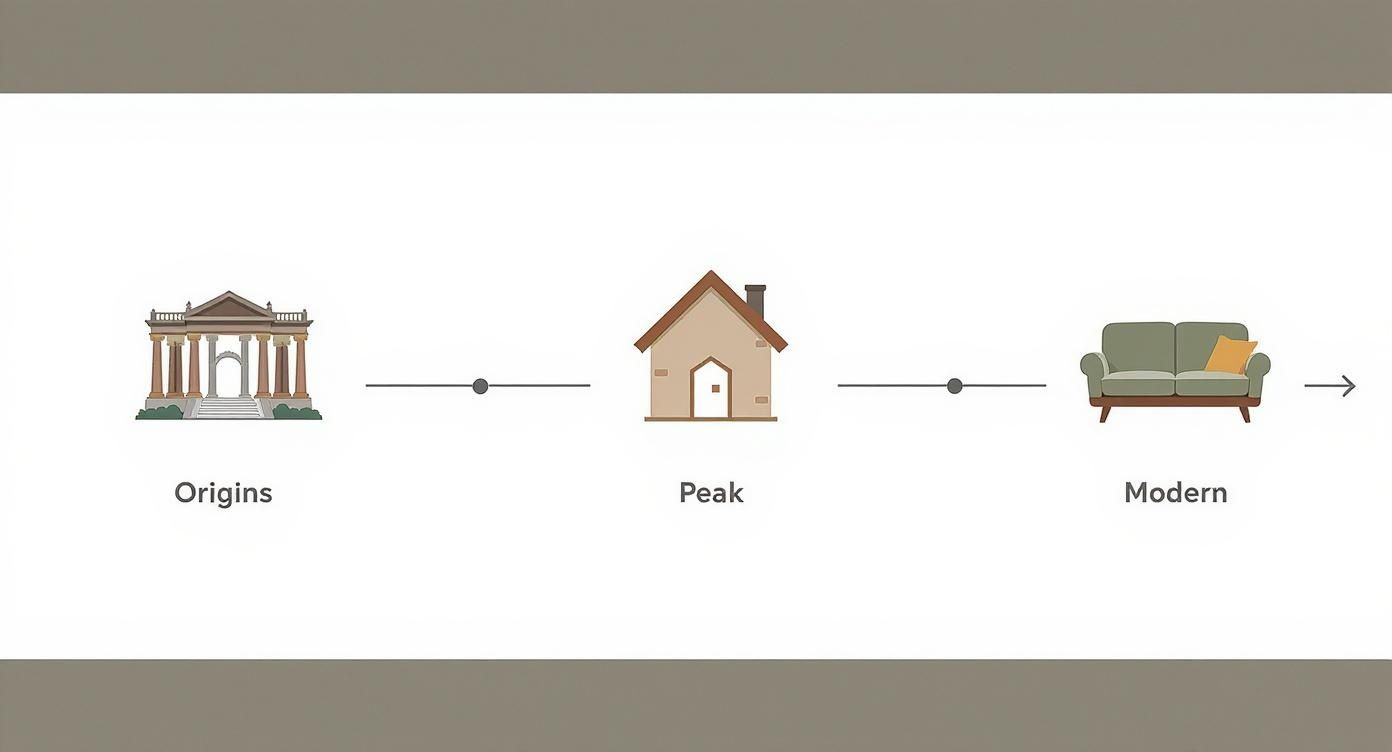
You can see how the style moved from strict, almost academic, replication toward something more accessible and simplified for a broader audience.
Post-War Shifts and Modern-Day Relevance
After World War II, Colonial Revival had to adapt to a new America. The post-war housing boom created a huge demand for affordable family homes, giving rise to the "Neo-Colonial" style that popped up in new suburbs everywhere.
These later versions weren't so hung up on historical purity; practicality was the new priority. They kept the key calling cards, like symmetrical fronts and double-hung windows, but the interiors were often streamlined.
- Simplified Details: The intricate crown molding and wainscoting of earlier decades were often swapped out for much simpler trim.
- Accessible Furniture: Furniture companies started mass-producing pieces inspired by colonial forms, bringing the look to the middle class.
- Modern Layouts: While the idea of a central hall often remained, floor plans started opening up to better suit the more casual way modern families lived.
Even today, Colonial Revival continues to evolve. Contemporary designers are constantly finding fresh ways to mix its classic elegance with modern tastes, proving this timeless style is anything but a stuffy relic. It remains a potent design language for creating spaces that feel both grounded in history and perfectly suited for right now.
The Architectural DNA of a Colonial Revival Home
Before you even think about furniture or paint, you have to understand the bones of a Colonial Revival house. The style's enduring elegance isn't just applied; it's built right in. These architectural features are the foundation for everything else, creating that signature atmosphere of formal grace and a deep connection to the past.
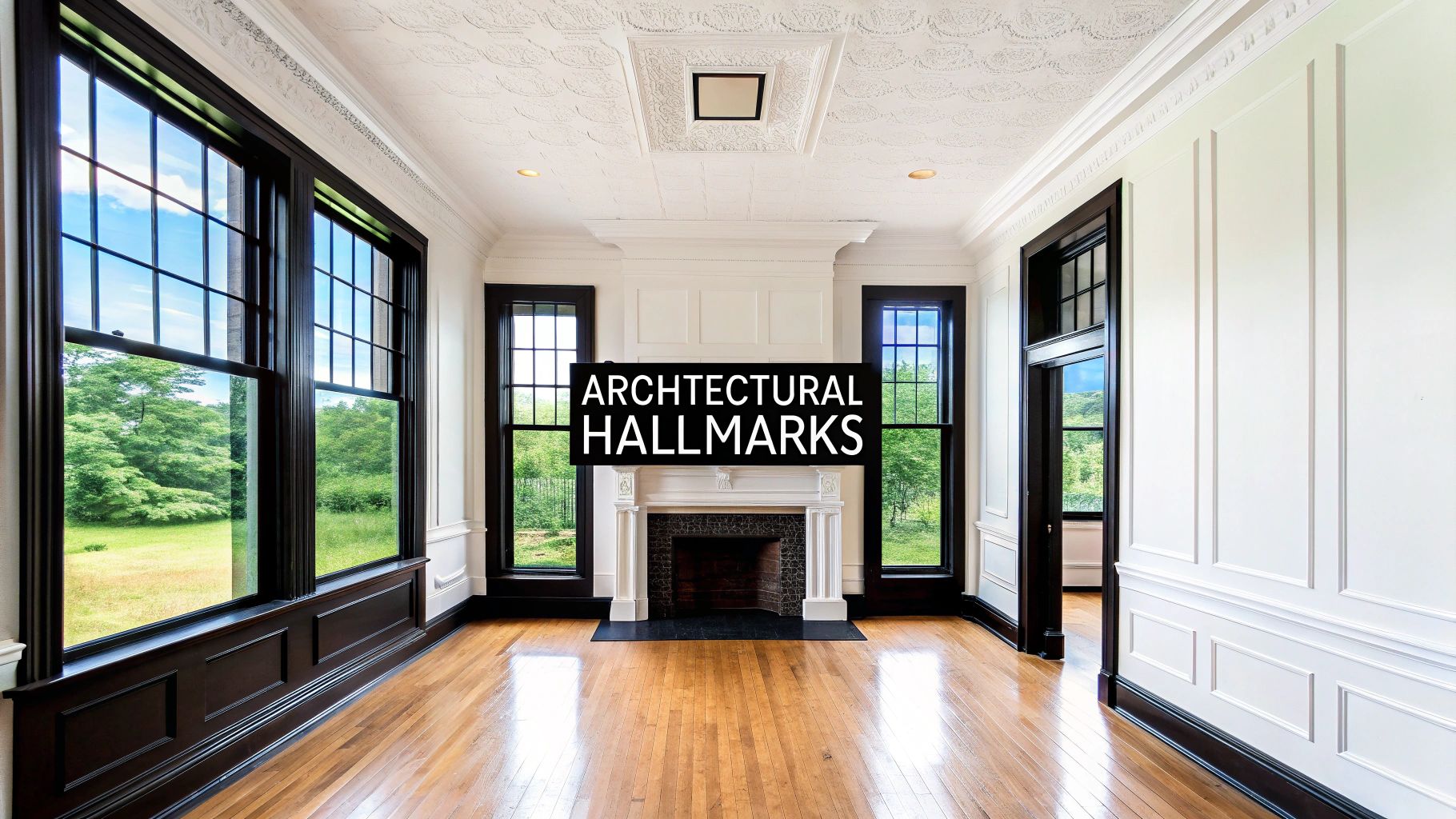
If there's one golden rule, it's symmetry. This isn't just a suggestion; it's the core principle that governs the entire design. A true Colonial Revival home is built around a central axis, giving it a comforting, predictable feel. You see this most clearly in the classic center-hall floor plan, where the front door opens into a foyer with rooms branching off on either side like mirror images.
This love for balance extends into every room. Windows, doorways, and even built-in shelves are often arranged in pairs, creating a visual harmony that feels stable and deeply satisfying.
It's All in the Woodwork
Beyond the floor plan, the intricate woodwork is what gives a Colonial Revival interior its soul. This isn't the rough-hewn simplicity of an actual 18th-century farmhouse. Instead, it’s a romanticized, more decorative version inspired by high-style classical details.
Here’s what you should be looking for:
- Crown Molding: We're not talking about a simple strip of trim here. Look for substantial, multi-layered crown molding that makes a statement. It’s common to see classical patterns like dentil (the little tooth-like blocks) or egg-and-dart.
- Wainscoting and Paneling: This is a hallmark of the style. You'll almost always find raised or flat panel wainscoting on the lower portion of the walls. In more formal spaces like a dining room or library, you might even see full-height wood paneling, which adds incredible texture and architectural weight.
- Door and Window Casings: The trim around doors and windows is never an afterthought. These casings are typically wide and substantial, often topped with decorative pediments or elaborate lintels that echo Greek and Roman architecture.
This dedication to detailed woodwork is a direct callback to the Georgian and Federal periods. It’s what gives these homes their solid, well-crafted, and undeniably formal character.
In a Colonial Revival home, the architectural details are the storytellers. From the symmetry of the layout to the profile of the molding, every element is a deliberate nod to history, order, and a certain vision of American tradition.
The Heart of the Home: Fireplaces and Windows
In any Colonial Revival room, the fireplace is king. It serves as the undeniable focal point, built with stately proportions and trimmed with classical details. Expect to see mantels flanked by columns or pilasters and adorned with intricate carvings that command your attention.
The windows are just as crucial to the overall effect. Multi-pane, double-hung sash windows are the standard, and their grid-like pattern is a key part of the home's structured, geometric aesthetic. They aren't just there to let in light; they are compositional elements that reinforce the home’s historical character, both inside and out.
A Style That Evolved
It's also worth remembering that not all Colonial Revival homes are the same. The level of detail often tells you when the house was built. The earliest examples, from roughly 1915–1935, were often high-end, custom homes that went all-in on historical accuracy, featuring grand Palladian windows and very formal layouts.
After World War II, the style adapted. These "Neo-Colonial" homes were built for the masses flooding into new suburbs. The details became simpler and the construction more streamlined, but the core principles of symmetry and classical proportion remained. You can dig deeper into this and see how Virginia's Colonial Revival architecture changed over time.
By learning to spot these key markers—the unwavering symmetry, the rich woodwork, the commanding fireplaces, and the multi-pane windows—you can start to read the language of a Colonial Revival interior. It’s how you get to the heart of a style that is so much more than just a collection of old-fashioned furniture.
Selecting Signature Furniture and Finishes
Once you've established the architectural shell of a Colonial Revival space—the millwork, the fireplace, the overall symmetry—it's time to bring it to life. This is where you furnish the room with pieces that give a nod to history but still feel right for today. We're not trying to create a museum exhibit; the idea is to choose furniture and finishes that capture the spirit of 18th-century craftsmanship, focusing on grace, good proportions, and timeless style.

The furniture you see in colonial revival interiors is almost always inspired by the work of legendary English and American cabinetmakers from the 18th century. You’ll hear names like Queen Anne, Chippendale, and Hepplewhite thrown around a lot, and for good reason. Their designs were so elegant and well-made that they became the blueprint for this entire nostalgic movement.
The Influence of 18th-Century Masters
You don't need a degree in decorative arts to spot the key silhouettes. These designers created forms so iconic they’ve been in continuous production for centuries, and they are the absolute bedrock of the Colonial Revival look.
- Queen Anne Style: This one is all about the signature cabriole leg—that gentle S-curve ending in a simple pad foot. It’s a delicate, almost feminine style you’ll often see on side chairs, small tables, and highboys.
- Chippendale Style: Thomas Chippendale's work is a bit more muscular and detailed. His calling cards are the classic ball-and-claw foot, elaborate carvings, and the iconic "ribbon-back" dining chair.
- Hepplewhite Style: If it looks light and airy, it might be Hepplewhite. Think straight, tapered legs and delicate geometric inlays. His most famous piece? The elegant shield-back chair.
As the style exploded in popularity, manufacturers started producing machine-made versions of these historic pieces, making them accessible to a wider audience. The focus wasn't on exact replicas but on capturing the refinement and balanced proportions of the originals. For a deeper dive, you can learn more about the evolution of Colonial Revival decorative arts and see how these pieces were adapted over time.
Identifying Iconic Furniture Pieces
To get that authentic Colonial Revival feel, you don't need to furnish the whole room with period pieces. Just focus on a few key anchors that really define the style. These are the focal points that set the tone for everything else.
The secret to a great Colonial Revival room isn't historical purity—it's thoughtful curation. A single, beautifully crafted highboy or wingback chair has more impact than a dozen mismatched, smaller pieces ever will.
Look for these classic forms to ground your design:
- Highboy or Tall Chest of Drawers: This is a statement piece. Often made of rich mahogany or cherry, its height adds a sense of formal grandeur to a room.
- Four-Poster Bed: In the bedroom, nothing telegraphs Colonial Revival quite like a four-poster bed. It can be simple and tapered or ornately carved, but it always commands attention.
- Wingback Chair: Originally designed to block drafts from a crackling fireplace, this cozy chair is a must-have. It’s perfect for flanking the hearth or creating an inviting reading nook.
- Camelback Sofa: Named for its distinct, gracefully arched back, this sofa brings a formal elegance to a living room without feeling stiff.
Of course, placing these substantial pieces takes a bit of strategy. For help creating a layout that’s both balanced and livable, take a look at our guide on essential furniture arrangement tips.
Choosing Essential Materials and Finishes
The finishing touches are what pull everything together. These materials provide the texture and backdrop that make the design feel cohesive and historically grounded.
Flooring and Hardware:
- Hardwood Floors: You can't go wrong with dark-stained hardwood. Oak, cherry, or mahogany planks provide a rich, warm foundation that everything else builds on.
- Polished Brass: The warm gleam of polished brass is an essential accent. Use it for cabinet pulls, doorknobs, and light fixtures to add a bit of sparkle.
Fabrics and Textiles:
- Chintz and Damask: For upholstery, curtains, and pillows, traditional floral chintz or woven damask fabrics are the perfect way to introduce pattern and texture.
- Oriental Rugs: A high-quality Persian or Oriental rug is the classic choice for anchoring a furniture grouping. It brings in rich color and complex patterns that complement the wood tones.
By pairing furniture with classic lines and complementing it with these authentic finishes, you create a space that feels both connected to the past and perfectly suited for modern life.
Bringing Colonial Revival into the 21st Century
Loving a classic style like Colonial Revival doesn't mean your home has to feel like a museum. The real artistry is in translating its foundational principles for the way we live today, creating a beautiful blend of timeless elegance and modern comfort. This isn't about a stuffy, historical reenactment; it's about a fresh, livable take on colonial revival interiors.
The idea is to capture the style's spirit—its love for symmetry, quality craftsmanship, and graceful lines—while making space for your own personality and 21st-century needs. Think of it as a friendly conversation between the past and the present, where classic shapes get a new lease on life with updated materials, colors, and layouts.
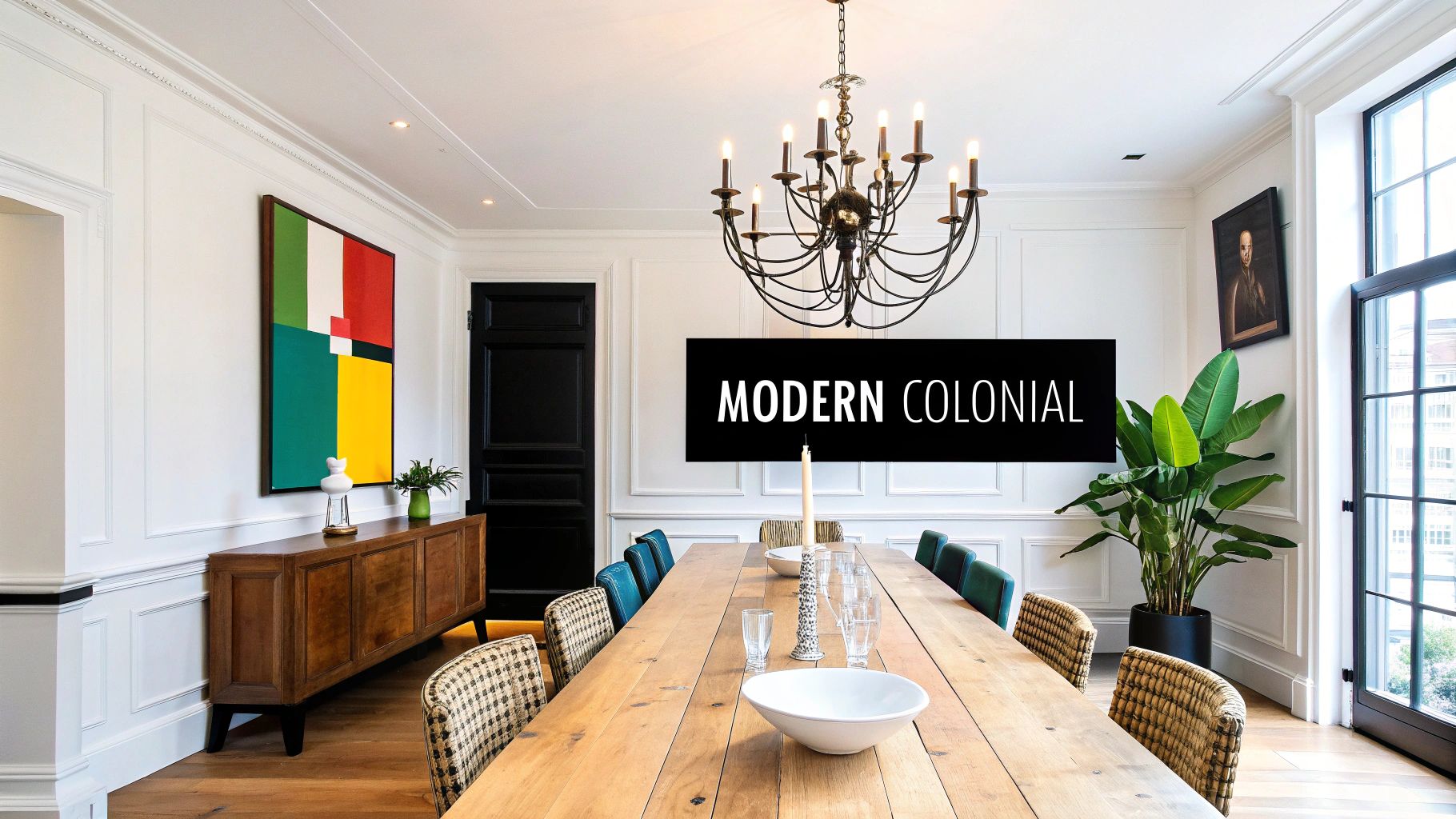
This balanced approach results in a home that feels deeply rooted yet perfectly suited for modern life. You’re aiming for spaces that are sophisticated without being stuffy, and structured without feeling rigid.
Lighten Up the Color Palette
One of the quickest ways to bring this style into the now is to rethink the color scheme. While deep, historic colors certainly have their charm, a lighter, more neutral backdrop can make a Colonial Revival space feel instantly more current and open.
Instead of defaulting to heavy burgundies or dark forest greens, try building your room around warm whites, soft grays, or even a subtle greige. These shades do a fantastic job of highlighting the home’s beautiful architectural details, like crown molding and wainscoting, without visually weighing down the room. They create a clean canvas that lets your furniture and decor really shine.
A modern Colonial Revival palette is less about being historically perfect and more about creating an atmosphere. Lighter colors shift the focus from old-world formality to a feeling of calm sophistication, making the whole house feel more inviting.
Mix Old and New with Confidence
The true magic of a modern Colonial Revival interior happens when you intentionally mix traditional pieces with contemporary ones. This contrast creates a visual energy that’s full of personality and keeps the eye moving. Don't be shy about pairing a classic silhouette with something sleek and unexpected.
Here are a few ways to nail this high-contrast look:
- In the Dining Room: Anchor the space with a classic, dark wood Chippendale-style dining table, but hang a sleek, minimalist chandelier above it. The clean lines of the modern light fixture create a stunning counterpoint to the ornate details below.
- In the Living Room: Take a traditional wingback chair and reupholster it in a bold, contemporary fabric—maybe a large-scale geometric print or a punchy solid color. Suddenly, a potentially stuffy antique becomes a chic, modern statement piece.
- Art and Decor: Hang a large, abstract painting over a traditional fireplace mantel. The contemporary art acts as a powerful focal point, injecting fresh energy into the room's classic architecture.
This kind of thoughtful blending is what stops a classic style from feeling dated. If you're ready to start experimenting, it helps to have a good grasp of the fundamentals of how to redecorate a room to ensure your updates work together cohesively.
Simplify Your Furnishings and Finishes
Finally, a modern interpretation of this style is all about simplification. Traditional Colonial Revival interiors often leaned into heavy draperies and layers of fabrics, but a contemporary approach favors cleaner lines and a more curated collection of furniture.
Choose simple, elegant window treatments. Tailored Roman shades, airy linen curtains, or even bare windows (if privacy isn't an issue) work beautifully. This change alone lets so much more natural light into the space, reinforcing a sense of calm and openness. The same goes for your furniture and accessories—be selective. A few well-chosen, high-quality pieces will always make a bigger impact than a room cluttered with too many small things. This "less-is-more" mindset is the secret to creating a space that feels both timeless and refreshingly modern.
Common Design Mistakes to Avoid
Getting Colonial Revival interiors right is less about following a rigid rulebook and more about finding a graceful balance. Still, a few common missteps can quickly turn a classic space into a caricature. If you know what to watch for, you can create a home that feels both authentic and genuinely comfortable.
One of the most frequent errors is treating the style like a historical reenactment. This path often leads to rooms that feel stuffy, cluttered with accessories, and just plain uncomfortable to live in. Remember, the goal isn't to create a museum piece; it's to capture the spirit of the era's elegance in a home that works for modern life.
Another major pitfall is getting the scale of your furniture wrong. Colonial Revival pieces, with their dark woods and solid forms, carry a lot of visual weight. Squeezing an oversized Chippendale-style sofa into a small living room, for instance, will make the space feel cramped and suffocating, completely ruining the delicate symmetry the style depends on.
Over-Accessorizing and Clutter
A true hallmark of Colonial Revival design is its sense of order and restraint. It's so easy to make the mistake of filling every last surface with decorative objects. This approach completely undermines the style’s inherent grace, creating visual noise instead of curated elegance.
- Don't Do This: Covering every tabletop, mantel, and shelf with small knick-knacks, faux-historical trinkets, and an overabundance of family photos. This just makes a room feel dated and messy.
- Do This Instead: Be selective. Choose a few high-impact accessories that make a statement—a beautiful pair of brass candlesticks, a classic ginger jar, or a single, well-framed piece of art. The key is to give your chosen items room to breathe.
This curated approach ensures that each piece actually contributes to the room's overall harmony rather than detracting from it.
The essence of Colonial Revival elegance lies in what you choose to display, not how much you can fit. A few well-placed, meaningful objects will always have more impact than a room full of clutter.
Using Inauthentic Colors and Finishes
Color is an incredibly powerful tool, but the wrong palette can instantly make a Colonial Revival interior feel off. Using bright, trendy paint colors or overly distressed finishes clashes directly with the style’s refined character. The look should feel established and settled, not artificially aged.
A neon accent wall or a shabby-chic painted table, for example, would feel jarringly out of place. It’s also wise to avoid overly glossy finishes that look too modern and synthetic. Instead, stick with palettes and materials that honor the style's roots while still feeling fresh.
The aim is for timelessness, not trendiness. That means choosing colors and textures with a soft, historic feel. By thoughtfully selecting your materials and hues, you reinforce the home’s classic and enduring appeal.
Your Colonial Revival Questions, Answered
Diving into Colonial Revival design often brings up a few common questions. Let's clear up some of the finer points to help you nail the look with confidence.
Colonial Vs. Colonial Revival: What's the Real Difference?
This is a big one. It's easy to confuse the two, but they come from completely different places.
Original Colonial homes, built between the 1600s and 1800s, were all about function. Think rustic, handmade furniture and local materials—it was a style born out of necessity, not luxury.
Colonial Revival, which kicked off in the late 19th century, is more of a romantic look back at that time. It's an idealized, polished version of the past, borrowing the best bits from high-end 18th-century styles like Queen Anne and Chippendale. The result is more elegant, symmetrical, and refined.
Think of it this way: Colonial Revival isn't about creating a historically perfect replica. It’s about capturing the feeling of 18th-century American grace and order for a more modern home.
Making It Work in a Modern Layout
How do I bring this style into my open-concept home?
It's a great question, since Colonial Revival traditionally loves separate, formal rooms. The trick is to create the illusion of distinct spaces without putting up walls.
You can use architectural cues like cased openings, elegant columns, or even half-walls to signal a transition from one area to another.
Here are a few other smart ways to do it:
- Create Zones: Use large area rugs to anchor your living room furniture or define the dining space.
- Lean on Symmetry: Even within an open area, you can create symmetrical vignettes. Try placing matching bookcases on either side of a fireplace or a media console.
- Keep it Cohesive: Tie everything together with a consistent color palette, the same style of trim work, and classic lighting fixtures throughout the entire space.
Are there go-to paint colors for this style?
Absolutely. The best choices are pulled straight from historical palettes. You can’t go wrong with muted blues, soft sage greens, creamy off-whites, and warm beiges on the walls.
For a more formal or dramatic feel, especially in a dining room or study, consider deeper accent colors like a rich burgundy, classic navy, or a moody forest green. The key is to stick with colors that feel soft and timeless, not bright and overly modern.
Feeling inspired to put your own spin on Colonial Revival? With a tool like AiRoom, you can stop wondering and start seeing. Just upload a photo of your room to generate incredible design ideas in seconds, mixing classic elements with your personal style. Play with furniture, colors, and layouts risk-free. See it for yourself at AiRoom’s website and start designing today.